Thursday, October 30, 2008

MTV Music censorship raising eyebrows two days after launch

On Tuesday, MTV made news by launching its new site MTV Music and posting to it over 16,000 videos. Ars Technica compared the service to YouTube, speculating that it is making greater progress than YouTube in its mission to host “every single music video ever created.” Today, MTV Music is in the news once again for something it has that YouTube doesn’t: strict censorship.

Earlier today, Techdirt reported that MTV had heavily edited the video of "Weird Al" Yankovic’s Don’t Download This Song, his sarcastic plea to physically purchase his songs rather than illegally download them, so that he can “afford another solid gold Humvee.” The censored words were not expletives however, but rather the names of file-sharing services. These are the lyrics in the first verse of the uncensored version, which you can hear on YouTube.

Once in a while maybe you will feel the urge
To break international copyright law
By downloading MP3s from file-sharing sites
Like Morpheus or Grokster or Limewire or KaZaA

As you can hear in MTV’s version of the video below, the words “Morpheus,” “Grokster,” “Limewire,” and “KaZaA” have all been inexplicably bleeped.


Obviously, the censoring of these words is nonsense. How could the names of already well-known file-sharing applications cause any deal of harm great enough to excuse bleeping them as if they were curse words? The context of the lyrics is enough to deduce the meaning of the omitted words, anyway. The censoring of the song seems to contradict the message of the song, in a way. It supports Weird Al’s view that the music industry is too paranoid about the threat of piracy.

Reading this article was the first I had heard of MTV’s new site, so I decided to explore the site a little. It seemed like a good idea after all, and I was willing to write this off as one very peculiar, isolated incident. I began by searching for one of my favorite songs (which you may recognize), and was pleased to find it despite the video being fairly new. I was impressed – that is, until I got to the second verse, which goes like this.

I want to roll with him, a hard pair we will be
A little gambling is fun when you're with me
Russian roulette is not the same without a gun
And baby when it's love, if it’s not rough it isn't fun

At least, that’s how the lyrics go in the video on YouTube. In MTV’s version below, the lyrics have been slightly modified, replacing the words “Russian” and “gun” with brief pauses.


After hearing the verse for the first time, I had to replay it thinking the audio must have skipped, but each time “Russian” and “gun” were incomprehensibly absent. Still baffled, I could hardly believe my ears when I got to the third verse:

I won't tell you that I love you
Kiss or hug you
Cause I'm bluffin' with my muffin
I'm not lyin’, I'm just stunnin’ with my love glue-gunnin’

Try to guess which word was censored this time. If you said “gunnin’,” guess again. Apparently, the censors feel that glue guns aren’t as threatening as those used in Russian roulette. The word “muffin,” however, they believe is too much for your innocent ears to handle.

That’s right. MTV censored the word "muffin." I don’t even want to know their reasoning behind that.

So is this MTV’s bizarre way of promoting gun control and condemning carbohydrates? Who do they think they’re protecting from these supposedly offensive lyrics? I hope no children would be watching modern music videos, and I don’t think the mere mention of Russian roulette is enough to make anybody want to play it, or even to frighten anyone.

Other than some questionable scenes featuring Gossip Girl's Chace Crawford, the video and lyrics for Poker Face are relatively tame, yet MTV felt the need to butcher it in order to eliminate references to metaphorical weapons and baked goods. Lady GaGa’s other video on MTV Music called Just Dance, in which she violates a plastic whale while singing about getting extremely drunk, is left completely intact. I'm just saying...

Games firms 'catching' non-gamers

Across the globe, a game firm has prosecuting innocent people for
committing to acts of piracy. Scottish couple, Gill and Ken Murdoch
were accused of file-sharing the game "Race07" created by Atari.
Even though the couple argued that they have never played a
computer game in their lives, they still received a letter informing
them of the legal actions that will intake if they do not settle with a
compensation fee. Gill at the age of 54, and her husband at the
respective age of 66 were appalled after getting the letter. After
a length of time the Atari dropped the lawsuit. Michael Coyle, an
intellectual property solicitor with law firm, Lawdit, assumed that
pirate steal or "piggyback" onto unprotected wireless services.
Gaming companies are trying to put a stop or monitor
peer-to-peer sharing networks like BitTorrent.
This article does spark the attention of individual to ask a question
whether an IP address is enough evidence. I think that companies
are taking extreme measures in trying to capture pirates and prevent further
copyright infringements.

McCain-Obama Dance-Off!!!


The video pretty much speaks for itself. My room mate first introduced me to this video and it is just one of the funniest things done since the election began. This is one of the most creative remixes done to the two presidential candidates.

It was first debuted on Minimovie.com and it insisted that you choose which candidate is the winner. Obama kicks it off with a challenge to his opponent John McCain by saying, "Can I kick your old Republican ass?" Then Obama and his crew proclaim the candidates campaign slogan, "Yes We Can". Pretty vulgar language by the democratic candidate, but McCain fires back saying, "You're pretty good for a Democrat".

The dance battle gets intense after this, both of their crews go at it until McCain challenges him one on one. Then they are interupted by a special guest challenger, the running mate of John McCain, Sarah Palin. Adding her to the dance off was pretty funny but if Joe Biden was also in it that would have taken the cake. Overall, it looks like it took a lot of work, and I think it was a great video that will lighten the mood before the election.

- Ronald Hudson

TED talk about cool materials for toys and other use

original article http://www.boingboing.net/2008/10/31/ted-talk-about-cool.html

We all love the intelligent, entertaining TED videos. I recently found one that so creatively applies to our class.

Two men named Zach Kaplan and Keith Schacht lead a research team that passionately looks for new and interesting products with extremely unusual properties. Six of these products were demonstrated in the TED video. I won't go into detail about all six of these, but you can watch the video for yourself to get the full effect. But I will summarize for you my favorite.

A Japanese company named GelTech sells small, soft magnets. I suppose they sell them as toys, though I'm not sure what a child is supposed to do with them. But Keith and Zach, fascinated by just the idea of "soft magnets," start rattling off possibilities that are unheard of to the world. Among these ideas is the world's fastest water slide. A magnet would line both the body board and the slide that would repel each other. Add water, and you have a slick, frictionless ride. (skip the video to 3:35 to see the concept). Truly proving that they are not phony scientists, they show how an aluminum tube can be used as a brake for the rider.

Another of my favorites was their use of a "dry liquid" developed by 3M. This substances evaporates 25 times faster than water, making it feel cold to the touch. This weird stuff has many fun applications. It is already used in sprinkler systems in many new buildings. Water guns could be loaded with it for battles which wouldn't damage the phone in your pocket or leave you shivering for the next hour.

Kaplan and Schacht, who call themselves "The Inventables," are masters of the remix. They understand, with more than a hint of nerdiness, the application of creative intelligence into the real world. They are hybrids of two mindsets - scientific inquiry and remix. But the "Inventables" have one major flaw: what have they invented? The guys like to talk the talk, but us consumers want to see them walk the walk. From the sound of it, they are great at thinking innovative uses for weird toys, but what have they created? If they can break through from the laboratory to the market, everyone would be better off. They claim that for three years they have been looking at over 200 different cool toys with unusual properties. Add that to the three years past since this talk was given in 2005 and it appears these enthusiasts have spent six years in this field.

Let's hope that someday we get to carry soccer goals in a duffle bag, have dry squirt gun fights, and ride the mile high water slide.

- Jordan Morsberger

Why Windows 7 Will Be Better Than Vista

Link to article: here

To put it simply, Windows Vista sucked. It had far too many errors and didn't run quickly enough -- it was a long way from measuring up to standards and expectations. As a result, Microsoft realized it had some revamping to do. Newer versions of Vista were released, and while Microsoft claimed to be proud of them, they still weren't great, and Apple was tough competition (as it always is).

So, after much remodeling and thinking, Microsoft has released yet another OS: Windows 7. With more emphasis on user satisfaction and less on simply meeting requirements, this model uses telemetry to meet the needs of Microsoft's customers. Telemetry, which is how satelites relay information back to bases, is used on Windows 7 to record user information and habits and send the information back to Microsoft, who then uses the information to improve the product. Windows 7 self-diagnoses and then fixes its own issues.

Because organization has been such an issue in the past with Microsoft OS products, the new version hosts Libraries, which are like the Smart Folders found in OS X. They store files with similar properties together. Also, the search now scans the entire range of accessable folders and not just the folders specified by the user.

Another issue in the past was troubleshooting. Users would call the help desk and not know how to answer the questions the Help Desk people were asking them. As a clever solution to this, there is now a client-side recorder on the OS. It records the actions taken by the user and also, at regular intervals, takes screenshots. When the user needs help, their screenshots are sent to the help desk, where people can see, click-by-click, the actions leading up to the problem, and can then help the user. A great feature on Windows 7 is that trouble shooting code is modifiable, meaning that the help desk people can simply replace code to help make the computer run better. Once issues are found, modifications can be made, and the OS is good to go.

A big, but pointless, problem with Windows 7 is privacy issues. People are angered over the lack of privacey (client-side recording), but really, when you think about it, this is pointless to worry about. Every time we use the internet, every action we make is recorded and sent to the Site hosts. Nothing about computers or the Internet would improve if information about the users wasn't being relayed back to the hosts.

So, in short, Windows 7 is going to be way better than Vista ever could be.

Wednesday, October 29, 2008

Record Label ‘Infringes’ Own Copyright, Site Pulled

Record Label ‘Infringes’ Own Copyright, Site Pulled.
http://torrentfreak.com/record-label-infringes-own-copyright-site-pulled-081019/

A record label by the name of Quote Unquote Records had a website up allowing free access to their music. They sought to be one of the first donation based record labels. However their website was pulled down for copyright infringement by their web host. The web host contacted the record label saying they had copyrighted material which they did not have the rights to access. The host asked them to send over the copyright registration forms by mail in order to get the website back up. This was a problem for the label because even though the copyrighted material was their original work, it was not registered with the US copyright office. They instead got their music copyrighted under a Creative Commons License (material can be viewed only if the website is up). With out the paperwork the website will remain down.
One person from Quote Unquote Records said "I guess the scary thing for me is that it seems that my hosting server employs a guilty before proven innocent policy, which is terrifying for anyone who does not physically mail forms for every small idea they’ve ever had in their bedroom to the US copyright office. What a great new digital age, stuck in the trappings of wasteful forms and red tape.” I think that's ridiculous, they were not doing anything wrong. Typical copyright laws being too strict. What do you guys think?


Ryan Wettlaufer

Tuesday, October 28, 2008

Google Thumbnails infringe on copyright?

Two German court have ruled that Google image search creating thumbnails to view before the user wants to go to the site infringes on copyright. Two lawsuits have been settled and now Google will have to remove thumbnails from their image search in Germany. The court ruled that Google is modifying the images illegally by creating thumbnails and is in violation of copyright law and that downsizing the images doesn't create a new work. Google is, of course, very pissed off. They're saying its a sad day for internet users and that business are going to take a major step backward because of it.

Personally, I think it's kind of stupid that the courts came to these decisions, but I do see how they could have gotten there. What will be interesting is if www.ask.com is up next because with one of their features you can actually preview the webpage. It should be interesting to see how this all plays out.

http://arstechnica.com/news.ars/post/20081013-german-court-google-image-thumbnails-infringe-on-copyright.html

Sir Ken Robinson

Sir Ken Robinson has a very critical outlook on education around the world. His speech on education at TED expressed his views in a very funny and what almost seemed lighthearted way. His message is very interesting and serious though. He thinks that the world is becoming less and less creative as a result of education prioritizing math, science, and other subjects that are perceived as more important over creative arts subjects. He argues that the education we receive kills creativity and that educational institutions around the world need to re-prioritize what they teach their students. He also thinks that the world is being taught more to be like college professors, which is a bad thing. He says that much college professors are brilliant, but they simply view their body as a vessel for their minds. He thinks that everything needs to be embraced and creative talents need to stop being shunned away.

I agree with Ken Robinson most things. I agree that people need to start looking at subjects other than English, math, and science. I also agree that people are forced into losing their creativity and didn't necessarily want to be. However i don't think that dance and arts should be as important as math or science. For most people, creativity needs to stay as a side hobby. Most people are just not as good as the select few creative people are at what they do even if they worked at it. While the arts need to be embraced more, it still doesn't make sense for people to start being artists instead of holding a regular job just because they want to, there just isn't enough room in the world for it. the arts just need to be incorporated more into our learning and hopefully creativity can live in people until they're older rather than flaming out when they're still young.

Studies: Social networks exploding, may appear in social government

link to article

Social networking sites on the internet have proven to be powerful tools in both social and commercial markets. They provide ways for people to connect with each other without actually being physically connected. Taking it a few steps further than IM or cell phones, these sites allow people to send emails, leave comments, post blogs and bulletins, post pictures, and advertise products. By allowing people to interact with each other online, these sites have shown the progress of the Internet and it’s capability to help connect people in the real world. Not only are these sites, such as MySpace and Facebook, advanced and extremely helpful, but they are also used by the majority of the population, which makes them perfect outlets for companies who want to get their messages out there.

Marketing companies and celebrities have taken advantage of these sites by creating their own pages and then connecting themselves to other pages and people. Through this method, especially on MySpace, bands and people have become famous, and companies have increased their popularity and profit.

Several years after the rest of the world bought in to this concept, the government is catching on. The sites could allow the government to share information with people and spread ideas amongst the people. While the idea is still a relatively new concept and there is not yet any information on the security of the government’s presence on the sites, the sites could be incorporated into government functions such as tax and revenue, health care, and education.

Dutch court imposes real-world punishment for virtual theft

Link: here">

The price of crime varies with the severity of the crime committed. Probably the most common form of crime performed – whether it be of physical or virtual items – is theft. Because of copyright laws, illegally obtaining music, video, or other virtual content is punishable by law. Most people would agree at least to the idea that obtaining the media without actually purchasing it is stealing because it is something that somebody actually made, and it belongs to them. However, what happens if what you steal is entirely virtual? That is, something that never existed in the first place? Artists and actors work in the real world to create things that are available in the virtual world, so the things they make are actual items. If something is created online though, and nobody worked to create it and nobody paid any money for it, is it still real? Apparently the Dutch court system thinks it is.

In 2001, an online game was released. It was meant for a large number of users to access and the point of the game was to role-play. Players were placed into a virtual world where they could learn skills and crafts and they could earn money by selling things they made. However, the point of an online game is just that – it’s a game. The people in the game aren’t real, the items bought and sold aren’t real, and the world they are living in isn’t real. In order to make our lives even more confusing, the a Dutch court decided to declare the opposite of that: the items in the game are real property.

A fifteen year old boy in the Netherlands walked into a fourteen-year-old peer’s room and physically assaulted him and threatened him if he didn’t give him the “property.” While the assault is an established illegal act, the court case did not deal with that – it dealt only with the property stolen. The two teens were sentenced to community service because the items can “belong” to you and therefore can also be stolen.

Monday, October 27, 2008

Computers Deciding what Music We Like

http://blog.wired.com/music/2008/10/mufin.html

The latest music recommendation engine, Mufin, will tell us what music we like using a serious of relational algorithms. Mufin developed by "the father of mp3s" Karlheinz Brandenburg doesn't pay attention to the artists you like. It decides purely from computations made off of over 40 aspects of music, like percussion, style, tempo, sound color, instruments, volume, dynamics and loudness. This often produces bizarre results. Most music recommendations will give you a band that is within the same time period and genre. Mufin's recommendations disregard all of this. Other music recommending services have much different ways of going about recommendations: Pandora radio consults music experts, and Apple's genius and CBS's Last.fm uses software that notices when artists and albums are in the same collection as each other. Mufin will completely disregard all human conception of musical association of whats hip and what came out in a certain time period. It focuses on attributes which can be assigned numerical values.

The author of the article tried the service and found strange results:
"The site told us that the Beatles' "Sgt. Pepper's Lonely Hearts Club Band" sounded like "Dirty Love" by Tim Feehan, Edo Zanki's "Wie Ein Feuer" and Rafael, Joe und Die Partysingers' "Freudenspender."
The author did say that the suggested song shared characteristics such as tempo, vocal range, and chord pace, but the songs often had different emotional messages that the computer could not pick up on. All though he does admit that only Mufin can pick up on certain things:
""It's really difficult to put together similar artists for David Bowie, because he has such a great diversity of music that he has been doing," explained Djekic. "This is why Mufin is purely song-based. You can have a song that is similar to another, but an album that is similar to another? Or an artist that is similar? It's really kind of difficult." By ignoring that data, Djekic said, Mufin's recommendations are more accurate."
In this way Mufin offers its user something new. The ability to find a song that is similar regardless of genre and time period. It presents the same abstract mood.

Sunday, October 26, 2008

Jeff's thoughts on Sir Ken

I came to college to figure out what I'm going to do for the rest of my life. What work I'm going to do for the rest of my life. I've been told many times to find what I love to do and make it my job. If I do what I love it won't seem like work and the money will come easily. Yet society doesn't put value in my passions. It puts value in sciences and maths. I'm not going to force myself to be interested in either no matter how lucrative they are. I'm simply not the greedy. Although one day I am going to have to face the working world, say goodbye to my parents and support myself somehow.

Sir Ken's discussion on the academic community's perceptions of the value of creativity related to my troubles, but even more so how much emphasis does the working world put on creativity? Can I find a job as an English major? My adviser says "sure, there are lots of companies looking for people with strong writing skills." But strong writing skills aren't unique or have anything to do with creativity. As an English major I enjoy letting novels take my imagination, and allow myself the chance to think about something new, but that’s just within school. The working world isn't concerned with my imagination; they are most interested in my writing skills which have to do with the organization of the English language which is far from being original.

The academic world reflects the working world, a population of people who come home from a job they dislike to indulge in what really makes them happy, their creative outflow. The solution to this is very difficult. How do we create more jobs that make the arts lucrative? Amateur music and art is not in high demand. Only the wide spread, mainstream artists can really make a living. Even then it is hard with the record company claiming all of your creations as their own.

I hope to find a job where I have a chance to be wrong and an equal chance to be creative. I want a job that takes my passions at full value and uses them. The search will be hard, but hopefully more of these jobs will be available to everyone, so we can do as we please.

Thursday, October 23, 2008

Sir Ken Robinson and Matt Mason: The Creator's Dilemma


Sir Ken Robinson’s talk was unusually entertaining for a lecture. Most seem rehearsed and artificial, with speakers who seem more concerned with appearing to say something new and profound than actually doing it. As I watched Robinson’s talk I was fascinated by his composure. His tone was oddly casual, and he didn’t seem to be talking down to the audience like many speakers. I asked myself if he was nervous speaking to such a large crowd, because his attitude was that of someone speaking to a group of two or three. Robinson also told clever jokes at appropriate times, another rarity among speakers, which helped to keep my attention. Not only was Robinson’s speech captivating, it was enlightening. Some speakers can go into twenty-minute tangents without making a clear point, but I could relate to every topic Robinson discussed. The one that most affected me was the revelation that “we don’t grow into creativity, we grow out of it.”


“Picasso once said this: he said that all children are born artists. The problem is to remain an artist as we grow up.”

When I was younger, the one word I most used to describe myself was “creative.” I loved drawing, music, and writing, and planned on majoring in art for most of my life. I realized some time ago that I no longer have a creative bone in my body. Instead, I’m now completely logical and analytical. I have little artistic ability, no musical talent, I hate writing more than anything, and I’m majoring in computer science. It has confused me how radically I’ve changed, and sometimes I miss the right-brained me. It had never occurred to me before Robinson’s speech how much of an impact education had on my creativity. One thing that has always been true of me is that I am a perfectionist. As I tried my hardest to meet the standards of (the current system’s idea of) learning, it’s possible that I just lost my imagination. Sir Ken Robinson’s talk made me think about this situation in a whole new way, and this assignment made me think about what other problems have resulted from the neglect of ingenuity. I then wondered, did the deterioration of creativity contribute to the pirate’s dilemma?

If you think about it, Matt Mason’s The Pirate’s Dilemma and Sir Ken Robinson’s Do Schools Kill Creativity? argue for a similar cause. Both say that modern culture is counteracting the potential of youth culture, and like Robinson, Mason believes young people should be encouraged to have a “D.I.Y." ethic. In chapter one, he describes a phenomenon he calls “punk capitalism.” The driving force behind the punk subculture, says Mason, was creativity. According to Mason, the development of punk involved kids learning one chord, then learning “maybe just two more,” then forming a band. He said this process had a tremendous impact on young fans, instilling in them the idea that creativity is more important than experience.


“Economist Joseph Schumpeter once said economic development requires 'gales of creative destruction.' Punk was a category five hurricane.”

Mason goes on to criticize punk for becoming commercialized, even though it started as an anti-establishment movement. “Punk was trying to give people a sense of purpose and freedom from capitalism,” he says. “So capitalism responded by selling us punk, and mass-produced Ramones T-shirts for the whole family are now sold in shopping malls across the world.”

What could have caused this shift? I think it was the same thing that Ken Robinson complained about in his talk. Just like school systems are killing creativity by forcing children to conform to their idea of education, punk was killed by its absorption into mainstream culture, thereby losing the creativity that made it unique. Of course, punk culture played a role in its own demise, while students have no say in public education standards. That is the fortunate thing about this situation, though. We have the opportunity to keep history from repeating itself. The stakes are much higher this time, so we need to rethink education before it’s too late. This dilemma is no longer that of just pirates; it is the dilemma of all creators.

Sir Ken Robinson @ TED

http://www.ted.com/index.php/talks/ken_robinson_says_schools_kill_creativity.html

Sir Ken Robinson says that "creativity is as important in education as literacy." This is a bold statement for the 21st century ideals of working hard in jobs that make you money. These jobs tend to be business oriented with skills in math, reading, and writing. Since children and young adults attending universities are being bred at a young age to be successful in 'useful' jobs, there is a lack of emphasis on the arts and creative skills.
He also stated that all children are born with creativity, as adults we can lose it or build upon it. We lose it by our public education system in America. Robinson also made a great note that it was not just a western problem, but a problem all around the world. This idea makes it seem more universal and more of a problem rather than just a national issue. Robinson said that not only do we need to change the processes of public education, we need to change our mindset on what education is.
Sir Ken Robinson also stated that education is inflating, meaning that degrees are meaning less and less. Where do we go from there? We need to branch out and become more well-rounded in all elements of education - meaning arts, music, and literature. Not only do we need to recognize other forms of education in the school systems, we also need to be creative with new technology improving everyday.
It is like the idea of circuit- bending. It does involve technology, so we are not exactly moving away from what we already know. It builds upon technology that we already know, while still being creative. Moving the wires around creating new sound, expressing a form of art, while being innovative. Sir Ken Robinson wants us to recognize our ability to be creative and have an environment where we can thrive.

Ken Robinson Says Schools Kill Creativity

Ken Robinson Says Schools Kill Creativity
http://www.ted.com/index.php/talks/ken_robinson_says_schools_kill_creativity.html


Sir Ken Robinson believes that creativity should be emphasized in schools just as much as literacy is. Why wouldn’t we breed our kids so they can become famous at acting, or guitar like Jimmy Hendrix? Ken agrees and thinks the purpose of the public schools is to create university professors. The whole education system is based on our ability to prove ourselves academically. Also the education system is focusing on enhanced learning for current jobs. Sir Ken Robinson thinks if the school system.

He also said that we as people do not know what 5 years in the future has in store for us. If we don’t know this how we are going to know what to teach to help students succeed for the future. Robinson at one point said that degrees will soon be worthless because the way to be successful is to think creatively.

I like his Ideas on the future, and teaching such things as creativity. Creativity is a great thing to have in the business world. I think kids who are taught a lot of skills like creativity, social skills, people skills, etc. are very important to survival in every day life. Will the emphasis on the importance of creativity in the learning system be changed?


- ryan wettlaufer

Sir Ken Robison

Sir Ken Robinson talk about the issue of selective education, where the school board, teachers and parents conform a child into one that focuses only on math, science and english by doing so we are molding generations around the world that’s primary focus is everything else other than the arts. Consequentially as a society we are taking away the creativity, individuality and authenticity that children generate on pure innocence into mechanized person who is submissive to the educational norm as a result society downsides the value of the art.

Adding to this is “no child left behind, act” which basically provides special grants and rewards to those schools whose student excels in math, science and literature. Because of this schools are now teaching to a test; providing more attention on those subjects instead of the arts. Which basically disapprove of an individual who become choreographer and painters or makes it hard to exceed in the arts because there are separate schools that primary focus is on that certain art. Since these schools are centered on one subject, they tend to be private schools, really hard to get in and very expensive. Overall our society has been one that continues the focus on the necessity or materialism that we have forgotten the value or importance of expressive creativity in any form.

Wednesday, October 22, 2008

A rant on education, knowledge, and creativity

Knowledge is not something that belongs to any one person. Even experts on a certain subject simply cannot know all there is to know about it. Learning is continuous- you never stop learning, nor should you. But since our pool of knowledge is continuously growing, how should people be expected to accept all of that knowledge as-is?
This is where collaboration comes in. Collaborative works (read-write works) are often the most interesting to me because of how different people approach a problem or situation. Allowing others to change or add to existing work or knowledge only strengthens the body of knowledge at large.
Encouraging children to learn what they are interested in may be viewed as being dangerous or frivolous because it is not directly geared towards eventually readying children for jobs. In that same vein, the arts are squandered because self expression is not always profitable. Sir Ken Robinson's speech really resounded with me, especially his anecdote about Gillian Lynne. Today, she probably would have just been put on Adderall and encouraged to study subjects she didn't enjoy.
I have always had a keen interest in personality theory, especially Jung's theories and the Myers-Briggs Type Indicator test. By this personality test, people with my personality type (INFP) are often inaccurately diagnosed with ADD or ADHD. Explaining the entire personality theory here would be incredibly time consuming, so I will explain briefly. Basically, people with the "NF" (intuition and feeling) combination in their personality type often display behaviors that would be branded as attention deficiency. Furthermore, NF people are highly creative, intuitive, imaginative, and innovative people. Many of the same behaviors that describe NF people also describe ADD or ADHD. Instead of embracing what the child is skilled at, many times NF children are simply seen as being easily distracted, inattentive daydreamers. A normal brain is deemed "disordered".
I have a fundamental beef with the way education is run in this country because it expects all students to be successful in the same way. Art and classes are viewed as inherently non-academic in most schools, but many students are successful in these subjects and not successful in traditional academics. Letter and number grades rule how school performance is viewed.
Learning is probably one of my favorite things in the world. I love hearing interesting new ideas and accounts of others' experiences. The idea of college excites me- the notion of taking classes in subjects I am interested in is kind of interestingly foreign to me. After spending my pre-college years in a traditional public school, I expected to have to learn things I was not interested in. However, college gives a broad range of interesting subjects to explore. I find that when I am interested in something, I can learn more easily. Why not apply this to grade school students?
There seems to be a link between our current form of education and copyright to me. Both unintentionally prevent creativity in the interest of monetary gain. Education's purpose is to ready students for jobs. And copyright laws keep a person's work "safe" from the influence of others. But without the ideas of other people, ideas cannot grow. An educational system that allowed free learning and collaboration would expand and strengthen knowledge for everyone.

A Conversation with Sir Ken Robinson

Direct Link

The video in class that we saw about Sir Ken Robinson is obviously a very influential, fantastic video about schools and their lack of the creative side of learning. In high school you had to do creative projects, but they weren't REALLY creative, more so how you can tie in whatever you are doing with a picture you got off the Internet
The TEDtalk was filmed about 2 years ago, and has since gained momentum on the world wide web, causing people to realize how true his words are. When asked if these results had surprised him, he stated, "Yes it has, pleasantly. I've been involved in this work for a long time, but even so, it's great that particular talk has been so widely distributed. It's been downloaded 1.5 million times now. I'm very gratified. I'm very passionate about all these things." He says that being creative is not just about painting a picture, or sculpting a magnificent statue. It is about being creative and imaginative in your work. Chefs should be creative with new dishes and recipes. In an office it is critical to be imaginative to turn out new and interesting ideas. He says that he knows many therapists that are creative as well.
He was asked about his son, who is now 23, and Sir Ken Robinson told a story about his son, when Sony PlayStation had first come out. His son, James, had asked if he could have the PlayStation as a reward for doing well on exam, and at first the answer was no. After he had done well on his exam anyway, they bought their son the system, and it barely even got played because SIr Robinson had built a swing for his daughter. The PlayStation was soon forgotten, but Sir Ken Robinson was still worried about youth now, because many young people do spend a majority of their time on front of computers and gaming systems, instead of being outside and being imaginative.

Tuesday, October 21, 2008

Sir Ken Robinson on Education

Hearing Sir Ken Robinson talk reminded me of something we read in Free Culture.

Robinson focused a large fraction of his talk on education. All over the world, in each and every society, music and kinesthetic disciplines are overshadowed by other subjects. In our society and many others, the hierarchy places science, mathematics, and language at the top. Fine arts, music, and dance are quite minor, if present at all. If education's purpose is brain development, why then is the left hemisphere trained so much more than the right?

This really made me think of how backward this is. For example, many of us are interested in art. A great number of people out there are very skilled with their hands and have creative ideas to go along with their skill. But somewhere along the way, someone tells the artist to "get real" - with the chances of being a successful artist so slim, why not study more practical subjects? This I see as a problem. Yes, it is true that not many art students will become professionals. But think of this: how many science students will become scientists? Not many. I would imagine that hundreds of thousands of students face this. Kids should be encouraged to find their passion(s) and work on developing that.

At my high school, students had to complete four years of science to graduate. Does the girl who will someday be a real estate agent need to learn physics? Does a second grade teacher need calculus? Such advanced subjects help the professional no more than learning dance. And I'm not trying to say that calculus is bad or that dance is bad - each person has different interests and should be encouraged to practice their interests.

Our education system needs balance. In addition to the "core classes," students should be developing creativity. In Free Culture, Lawrence Lessig examines such a program in San Francisco. "Just Think!" is a program that trains kids in what is being called "media literacy." Two buses house high-quality digital video equipment. Each year, over thirty schools have the privilege to participate in Just Think! Its aim is "to make [kids] literate about the way media works, the way it's constructed, the way it's delivered, and the way people access it," according to Dave Yanofsky, Just Think!'s executive director. Because of this program, hundreds of kids get to practice making movies. Some skeptics might say that this is useless, since very few people ever make a movie. But the same can be said about studying Latin or science; it's not necessarily about the actual thing you are learning, but rather the learning process itself.

If we are trying to develop students through education, the process ought to be holistic. Sir Ken Robinson sounds like he understands this. It would be nice if school board members and principals could understand this as well.

- Jordan Morsberger

Sir Ken Robinson Talk tie back

To me, the most interesting thing that Sir Ken said was that ADD and ADHD are just inventions that essentially snuffing creativity. Both of these disorders are recent inventions, within the last few decades, and now there are all kinds of medicines who's sole purpose is to quell the restlessness in the children with these "disorders". He gave the example of the famous choreographer. As a child she was restless all the time and wasn't doing well in traditional school. When she went to the doctor to see what they could do, he showed that there was nothing wrong with her, but instead she just wasn't supposed to be in traditional learning environment. She was supposed to be a dancer. Like we talked about briefly in class today, the public school system is moving more towards discouraging artistic expression and education becuase of the No child left behind act. This basically means that instead of encouraging creativity by means of discussion and creative projects, they teach straight from tests, so the students only learn what is absolutley necessary to pass the test. If this act wasn't existant, or the schools weren't penalizing for not doing as well as they should, there would be more art and creative classes, and the regular classroom discussions would be more creative, and there would be more actual discussion instead of just blurting out and memorizing facts to just regurgitate them when they take the test.

Sunday, October 19, 2008

New music site rewards fans for buying songs

While most online stores that sell music are designed to take money out of your pocket, this new website has a new idea. Popcuts.com has come up with a new idea that pays users for downloading their songs. When a user downloads a song, the user gets “paid” for every time that song is downloaded after they download it. This keeps users downloading and telling other users to use download new songs and therefore spreading music that people like around the website. They then get website credit that they can use on other songs. This is beneficial for new artists also because users who download their songs have an incentive to tell other people about the music they downloaded. Also users have the incentive to buy these new songs because they could eventually make a profit off of downloading certain songs.

The site is also a good way for new artists to get their stuff heard. Anyone can upload music to the site to download. Popcuts take around 10-20% of the sales from each song, and the artists choose how much they receive from each song and then the rest goes towards the money users receive from having the song downloaded after they download. This means new artists can influence consumers to download their songs by making the amount the people receive higher for their songs. Artists songs are also fully protected when they’re uploaded onto the site so nobody can steal their work.

Unfortunately, when an idea like Popcuts.com comes around, there are bound to be problems. The website doesn’t have a lot of artists on board with their site. The reason is because since most artists are signed to record companies and have deals, they can’t decide to put their own music onto Popcuts. They only have a few small record labels signed so there aren’t that many songs or artists. Big record labels will probably shy away because they won’t get the kind of money they would from signing with a site like Tunes or Apple. But for small artists and labels looking for more exposure, Popcuts is a perfect choice with its unique business model.

http://www.cnn.com/2008/TECH/ptech/09/03/music.site.ap/index.html

McCain's campaign letter to Youtube

link: http://www.eff.org/deeplinks/2008/10/mccain-campaign-feels-dmca-sting

October 13th the McCain Campaign sent this letter to Youtube.

"Overreaching copyright claims have resulted in the removal of non-infringing campaign videos from YouTube, thus silencing political speech. Numerous times during the course of the campaign, our advertisements or web videos have been the subject of DMCA takedown notices regarding uses that are clearly privileged under the fair use doctrine. The uses at issue have been the inclusion of fewer than ten seconds of footage from news broadcasts in campaign ads or videos, as a basis for commentary on the issues presented in the news reports, or on the reports themselves. These are paradigmatic examples of fair use..."

The EFF is glad to see that at least presidential candidate sees the importance of freedom of speech on Online communities and the remix culture. The Obama campaign has also had problems with video takedowns by large companies, indicating this is a bipartisan problem. The EFF, Citizen's Media Law project and the Fair Use Project have all realized these problems years before and have been striving to fix them.

Although McCain has realized the problem he does not offer a solution that the online community likes:

"We believe that it would consume few resources--and provide enormous benefit--for YouTube to commit to a full legal review of all takedown notices on videos posted from accounts controlled by (at least) political candidates and campaigns."

The problem is the McCain campaign wants Youtube to take priority over everyone else's problems to fix their problems. As a public source of opinion the most exciting and useful videos are of the voters themselves expressing their views, not a large campaign with the financial funds to just as easily put their videos on TV while the common user has no other public outlet.

The bad guys are the major news media outlets. They send false takedown notices for videos which only contain a few seconds of the media's footage. They need to give free use a wide birth and realize the online communities' freedom to express themselves. The EFF and both campaigns are looking to sue these major news media outlets under the DMCA for their biased takedown notices.

Recently the McCain campaign has identified the news outlets of being: CBS, Fox News, and CBN.

I am angry that the news media outlets would try and limit our expression, while they express themselves constantly. It's like they think only they can express themselves, because they're the news and that the common man shouldn't think, but just listen to the news and believe it. Also I am concerned with the McCain campaign. They should realize that non-funded everyday citizen need an outlet as well and that they trying to take priority over one of our only outlets to speak and be heard by more than the people in the room.

Thursday, October 16, 2008

McCain seeks special 'fair use' copyright rules for VIPs

http://news.cnet.com/8301-13739_3-10066570-46.html


John McCain and his presidential campaign has run into trouble with some of the aspects of American copyright law. McCain's has been using the Internet, one of the worlds largest mediums, to support his campaign. His campaign has been uploading videos onto YouTube using that site to get people to view his content.
YouTube, however, has been removing his videos because of complaints saying that they are not in compliance with the fair use laws. This out rages McCain and he feels that his videos should not be removed because he is a presidential candidate. He proposes that any complaints about videos uploaded by a political campaign would be reviewed by a human employee before any removal is put into action. The process for complaints against videos uploaded by millions of other Americans would stay the same. Their videos would be instantly removed by a computer program, and would take weeks for reinstatement. McCain just wants to be treated special, rather than like every other human being that uses YouTube.
YouTube rejected the request made by McCain and continues to delete videos that are no in compliance. John McCain's campaign is now protesting You Tube's video-removal policy, which has resulted in the deletion of some political advertisements the campaign believes are perfectly legal and protected by fair use. His campaign has points out that YouTube seems a bit too eager to remove political videos.
I think that the best solution for McCain is to find another site to share his videos. Who says that YouTube is the only site that videos can be shared on. His campaign just needs to be more creative in finding ways to reach people.


- Ronald Hudson

"Nebraska Senator Sues God to Stop Terror Threats"

Original Article

by Ryan Singel

Ernie Chambers, the Nebraska State Senator, astounded individuals after he filed suit against God on September 17, 2007. Chambers argues that the court should stop God and his followers from making terrorist threats.
The lawsuit was filed at a district court in Nebraska, where Chambers challenged God and his followers of continuous terrorist threats of great harm to an immense number of people.
The allegation placed on the “Almighty and his followers” consist of: devastating floods, earthquake, hurricanes, tornadoes, plagues, famines, drought, genocidal wars, and birth defect. As well of being held responsible for striking fear, dread, anxiety and terror in the hearts of many to the point of unflinching submission. Also Chambers want the court to prohibit God from “issuing plagues, and terrorist threats.”
Chambers even goes as far to explain that God does not need to be in a court room because he is everywhere. Because God is everywhere he can be easily connected to Nebraska’s court jurisdiction. Since God is all knowing, the court system does not need to serve him with a notice of the lawsuit. “The lawsuit indicates that Chambers attempted to make God appear in order to serve him by saying ‘Come out, come out, wherever you are,’ but the Almighty declined…” (Singel). The reasoning behind this was to prove that the state constitution permits lawsuit to be filed regardless of the reason.
Externally this article has nothing to do with our class, but if you look internally it does. This can easily show that certain rules and regulation should be brought to the peoples attention has well as display copyright needs to be re-evaluated because it is just like this article silly. If I buy a CD, I should do what I please with it. And I thought it was funny.

Wednesday, October 15, 2008

Music takedown strikes the wrong chord

http://www.thestar.com/Business/article/271389

Almost one year ago to this day, thousands of musicians were upset to find that one of their favorite web resources had vanished. The International Music Score Library Project (IMSLP), home to tens of thousands of pages of sheet music, was taken down by creator Edward W. Guo when Universal Edition, an Austrian music publisher, got involved. Universal Edition ordered the IMSLP to block European users from using the site. Guo, better known by his username Feldmahler, planned to bring the website back up once he was able to calm his Austrian predator, which proved to be pretty tricky. In case you don't know what is meant by the word "score," it's just another word for sheet music. For the piano, it would look like this.

IMSLP servers are physically hosted in Canada; therefore, the website is under Canadian law. All scores submitted to IMSLP either belong to the public domain, or permission has been granted by the holder of the copyrights. In Canada, the requirements for a copyrighted work to enter the public domain is 50 years after its issue, as opposed to our 70 in the United States.

After taking the site down, Feldmahler wisely sought legal counsel. He believed what he was doing was legal, but he feared Universal Edition. For all he knew, they might have been days away from suing him for each piece of music that did not comply with Europe's definition of "public domain." While I do not know European law, from what I understand, the sheet music to many songs that are fair game for us North Americans to share are not fair game in Europe. The Canadian Internet Policy and Public Interest Clinic (CIPPIC) helped Guo ensure that his project was legal. Also, Lawrence Lessig and professor Michael Geist referred the case to several others, helping shed light on the injustice.

On June 28th, 2008, Feldmahler resurrected the website with its same library of over 16,000 documents. He also opened with a letter that reminded "publishers" (i.e., those submitting music scores) that the IMSLP was not created to oppose the music publishing industry, but rather to complement it. A classical music fan, I found this website a few days ago. It's a wiki-page. You will notice how similar it looks to an ordinary article from wikipedia.org. These days, anyone can start a webpage like this. Hundreds are created every week, but the majority of them fail to attract a significant number of visitors.

The IMSLP is once again building steam. The library currently houses over 21,000 pieces of music. I had assumed that these were mostly classical pieces, but surprisingly, pretty much all music styles can be found on the site. Scores are carefully categorized chronologically, by composer, and in some cases, by instrument. It's a cool site and, like all wikis, all users can add to it. However, Feldmahler regulates the site very well and insists that every single piece of music is legal.

It's a rare case that those at the frontline of Internet creation go about it in a completely legal way; the folks with the IMSLP, which includes a host of avid musicians in addition to Feldmahler, are doing just that. I hope that others will follow Edward Guo's example by using the World Wide Web in creative, helpful ways from which any of us can benefit.

- Jordan Morsberger

Thursday, October 9, 2008

Apple MacBook Rumors

On October 14, there will be an unveiling to the press of the new MacBook at Cupertino. The invites display an image that show a black MacBook with words below saying, " The Spotlight Turns to Notebooks." Of course with this veil of secrecy, there are rumors going around of what the new MacBook has to offer.

The last major revision for the Apple MacBooks was back in 2006. There have been slight modifications since then, but still nothing completely changing. One of the rumors going around is that the now currently Intel's Montevina platform will be replaced with nVidia chipset in the new notebooks. There are reports that say that the price of the MacBook will go down to $800 instead of the current price of $1,099. This will help Apple compete against PC's that sell at Best Buy and Staples with there laptop prices reaching towards the $599 range. Another rumor is that there will be 13-inch screens for the notebooks and for the MacBook pro there will be 15 and 17-inch monitors as well. The final rumor coming from AppleInsider.com and Macrumors.com report that the new notebook will be made of complete aluminum, such like the MacBook Air. This is different from the current versions where the laptops are made from plastic or a combination with plastic and aluminum.

We will know if all of the rumors are true after the October 14 unveiling. I think the most important claim made in the article would have to be about the prices of the laptops. With the recent battle between PC's and Apple, it would seem like the perfect solution to gain customers and really compete for profits. The lowering of the price, I think, will convince many PC users or those who are unsure switch over to Apple.

Internet News Article

Fake YouTube pages used to spread viruses...

(click Picture ^^^)
Criminals are getting better when it comes to finding way to put viruses on our computers. Who would have thought that they would be able to create an exact replica of a popular web page for the soul purpose of screwing up your computer.
When it comes to the Internet we all know the normal ways that hackers try to spread there viruses. Usually when we are surfing the web we encounter many pop-ups that try to lure us into the trap of downloading something that could possibly be the death of our computer. Everyone eventually caught on and now the biggest rule when surfing the Internet is not to download anything. Now hackers are even sneakier, making fake YouTube pages in order to spread their viruses.Online programs circulating throughout the Internet help these hackers create their replica pages.
People would receive an e-mail pointing them to one of the pages, once they clicked the link they would see an error message that claims the video they want won’t play without installing new software first. That error message includes a link the hacker has provided to a program, which delivers a virus. To top it off, once the computer is infected, the hacker redirects the victim to a real YouTube page to see videos they were hoping to see, just to hide the crime.
This new tactic sounds like it would be very effective in tricking people to download harmful software onto there computers because YouTube is a very popular site. Seeing how popular the site is makes me believe that it is a trusted site, most people would believe to download something if YouTube said that you had to in order to view a video.
Hackers have been successful with these fake YouTube pages, fooling people into downloading harmful software. Internet users should look out for warning signs of these fake YouTube like; web browser won’t show the real YouTube’s Internet address. Also to even get to the page you have to follow a link which should tip you off to whether the site is legitimate.
-R.Hudson


YouTube wants you to listen to music legally, listen to comments aloud

You may have noticed that YouTube has recently implemented some new features. One of them is a very progressive idea, while another is just plain bizarre.

The first feature lets you buy many songs directly from the pages on which you hear them. Music videos uploaded by certain YouTube partners, like EMI, now feature Amazon MP3 and iTunes links below the videos. As Jacqui Cheng of Ars Technica points out, the links are very unobtrusive, and may even be difficult to spot if you’re not looking for them. Below is a capture of the video for Goldfrapp's Number 1. Notice the links to the Amazon and iTunes stores at the bottom.


These click-to-buy links are also appearing for other media. Links to things like video games are featured on the pages of some game trailers. Google says they would like to apply this practice to even more kinds of videos. Cheng proposes that this technology could be used to feature links to buy songs used in mash-ups. This could be accomplished with audio fingerprinting, which YouTube is already using to prevent unauthorized uploads. Unlike its current use, fingerprinting would then benefit viewers as well as the content owners. Of course, uploading mash-ups in the first place is illegal, so it would be somewhat contradictory to the technology’s original purpose. Once again, everybody loses because of a read-only culture.

Download links are currently present only on the US site, but Google plans to expand the feature to include other countries and content providers. They’ve also hinted at possible changes in the UI – probably a good idea if they want people to notice the undistinguished buttons.

I think this is an excellent idea that should have been implemented a long time ago. It will certainly help to quiet opponents of YouTube like Viacom who don’t want their content posted on YouTube. It gives them the unbeatable incentive of having their content easily available for purchase on the pages they often try to have removed from YouTube. It may even inspire an increase in uploads by copyright owners, since it’s essentially free advertising for their material. After all, how could anyone accuse YouTube of promoting piracy when they explicitly encourage users to purchase the media featured on their site?

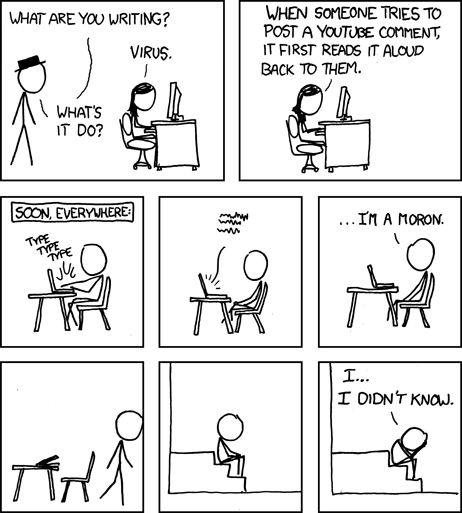
YouTube users will also notice that commenting on videos is now different. The second new feature is the seemingly frivolous ability to have your comments read aloud to you before you post them. Webcomic xkcd speculates that it was their comic (seen below) featuring a suspiciously similar tool that inspired the latest addition to YouTube’s interface.


It would be very amusing, if an obscure, but funny comic prompted YouTube to implement this feature. While it’s not the most useful tool, I don’t see why people are complaining. If you don’t like it, how about not using it? Anyway, it’s not that pointless if you think about it. I would say about half of the comments on YouTube are rude, ignorant, and/or unnecessary. If this option creates a scenario like that in the comic and prevents even one of those “moronic” comments, then it will be worth it.


The ability to buy songs directly from YouTube is a huge development in the battle between copyright holders and sites like YouTube, that the industry desperately needed. On the other hand, the addition of an audio preview for comments is an insignificant option that nobody needed. At the end of the day though, progress has been made in the push for digital rights, and audio synthesizers are always fun to play with.

Sources:

YouTube intros links to buy music featured in videos
YouTube Audio Preview

Team 3 - Cory Doctorow Analysis

In his speeches, Doctorow didn't really impress me with any facts. I knew why certain companies like Microsoft had better record company deals than Apple had, or cable tried to screw over the VCR companies. What i was impressed with is how he tied it all together. He somehow managed to go all the way back from the phonograph all the way up to the internet and pirates today. He also did it while providing solid, concrete opinions that included court cases and facts to back himself up. His analysis on the history of the pirate in general I thought was great. You didn't even have to pay attention that much, it was pretty easy to follow, but I did and thought his whole analysis was fantastic. He also gave his thoughts on the future of what would happen with DRM, pirating, and the record companies and even those thoughts were well founded. He obviously did his research and it helped make the speech a lot better for me how he tied it in.

One interesting part of Doctorow's speech was when he pointed out that copyright law is driven by piracy and, in a sense, by hypocrisy. When new technologies are introduced into the recording industry, the old institutions accuse them of piracy. Consequently, copyright law is changed to facilitate the new technology and to quiet those trying to prevent it. Eventually, the new technology becomes the old institution, accusing newer technology of piracy. This cycle has been repeating itself over and over since the invention of the phonograph. It reminds me of the read-only vs. read-write debate -- when someone's creation is used in a way of which they disapprove, they accuse the person using it of breaking the law. Unfortunately, the same progress isn't being made in that situation.

Team 2 - Doctorow

Although Cory Doctorow mentioned many different aspects of copyright and DRM music, the most interesting part about his speech on video would have to be him mentioning how he publishes eBooks and using it as an example to back up his free sharing idea. Doctorow mentioned that the companies trying to prevent piracy and prevent free sharing of music are going to fail, because the simple fact that suppressing downloading, at this point in time where there is no turning back, is ludicrous. Doctorow publishes many of his science fiction novels online available to the public for free. He said he has had financial success with his novels and they are being printed in many different languages through Amazon. His success should be seen as an example of the possibility for most publishers, musicians, and artists to put their products on the internet for free use, knowing that people will purchase their products if they really enjoy it.

Cory Doctorow also talked about license agreements. EULAs, or end-user license agreements are something everyone is familiar with, even if one doesn't know the name. EULAs usually pop up before software is installed and are followed by an "I agree" box. Since most EULAs are long and uninteresting, most people do not read them before agreeing. However, by using the software, the user automatically agrees to the terms set in the license agreement. This can present problems, as people usually do not read these agreements before installing applications like iTunes.

Doctorow also speaks about how many companies are trying to prohibit the use of open source software. I thought this was interesting because I use alot of open source software. He talks about the world intellectual property organization working on a broadcasting treaty which would prohibit the use of open source software internationally. Now every computer comes with a trusting computing module on its mother board which chooses which applications are allowed to be compatible with it. Doctorow uses the example of Open Office only being able to work if Microsoft says it can. The idea of this, a computer being able to choose which programs can run on it came from the IT companies, the companies that we support. Computers shouldn't have the power to choose what programs are compatible for it. Any program that we have, whether we created it, paid for it, or got it for free should be able to run on our computer that we own.

Analysis: data mining doesn't work for spotting terrorists

http://arstechnica.com/news.ars/post/20081009-analysis-data-mining-doesnt-work-for-spotting-terrorists.html


Earlier in the week, the NRC published a report about data mining and how it could possibly be used to prevent terrorism. This article talks about how the NRC thinks it works, how it actually works, and how it is bad for the American people. The first thing that the author says is that betting national security on data mining is basically praying for the incompetence of the terrorists, and with today's increasing sophistication of all people, that just isn't every likely. He describes the data mining technique as a action where you "vacuum up all of the world's information into a giant computer and mine it for terrorist clues". And this type of thinking, as he and many others say, has happened only recently after 9/11.

The biggest concern that he has about the inefficiency of data mining is exactly that. It IS inefficient, ineffective, and random at best, and it seems even unconstitutional. They are using an astronomical amount of power to suck up as much data as they can, and then using just as much, if not more power, to sort through all of that data searching for "terrorist clues" which usually don't even exist. They end up sucking up private information for honest people who have done nothing wrong. The author points out how ineffective it is in catching terrorists as well. Because most terrorists have no criminal past, and are usually just ordinary citizens, you are not able to find them like that. Little is known about training, so looking for training clues is out of the question. And even if we did know about their training or anything, it would still be nearly impossible to find them using data mining because of the use of "code words", that make it seem like they are just having a typical conversation with someone, and information hiding.

I thought that this article was very interesting, mainly because it showed that the government has recognized that technology is a good way to search for terrorists, but there is a right and a wrong way to do it depending on the case. The biggest concern I had while reading was whether or not they filtered the data that they collected, or if they just took all of it, i.e. They could get data from my computer, and then get data from a terrorists computer as well, but since its all there I could get jumbled in with his data. And the fact that, given to the wrong person, anything collected could be used badly.